
Taekwondo History
Summarised by Master Bradley
Note: This is a summary from a number of Taekwondo texts which were published in Korea 1980~1995 of which were sanctioned by the World Taekwondo Federation. The information is provided in summary form only and is intended for general informational use and should not be relied upon for research material in assignments or otherwise as the information is subject to change by the South Korean Government (Romanisation rules & Dynasty names etc).
Origin Of Taekwondo
Ancient Times
"Taekwondo" literally means the "art of hand and foot fighting". The origin of Taekwondo is obscured by many thousands of years of Korean history. The first organised development of Taekwondo martial arts training is thought to be around the first Century on the peninsula of Korea over 2000 years ago when the Three Kingdoms (Silla, Goguryeo and Baekje) ruled. However, it is estimated that Taekwondo was practised in a primitive form of martial art style in ancient times as far back as 5000 years ago. In those ancient times, there was no means of self defence other than bare hands and the body for a weapon. So it was natural to assume that bare-hand fighting martial art techniques were developed.
It is suggested that Taekwondo was first practised as a method of evading attacks from wild animals as well as a useful tool in hunting for food and also as a means of strengthening the body. Martial art techniques were learned from the experience of fighting against beasts whose defensive and offensive motions were the subject of analysis and mimicking. Since attacks could originate from any direction, martial art moves were developed that allowed reflexes to counter from any direction. Specific patterns were formed for instinctive self defence which became a series of blocks, kicks and strikes. These patterns are still practised today.
Evidence of Origin
There is some speculation that the martial art style of Taekwondo is not indigenous to Korea and that it is a break off of Chinese and other Asian martial arts.
The legendary origins of the Eastern (Chinese) martial arts are generally ascribed to a Monk from India called Bodhidharma. According to legend and ancient Chan Buddist texts, Bodhidharma came to China in the Sixth Century AD where he founded a monastery at Shaolin-So. He began to teach breath control and meditation. But his followers were physically incapable of practising the strenuous techniques, so he taught them methods of strengthening their bodies and their spirit. These methods later combined with Taoism and I-Ching to form the basis for the Chinese martial arts of Kung Fu, Kempo and Tai Chi Chuan.
In Korea, the first tangible evidence of Taekwondo dates from the Three Kingdoms period where a mural painted on the wall of the Myung-Chong tomb located in Tunsko (Capital of Goguryeo) and built in the Goguryeo Kingdom sometime in the First Century . The mural shows two youths sparring. Other tombs found in this period contain similar murals which show figures practising martial arts. Accordingly, there is evidence that Korea was developing it's own martial art well before Bodhidharma arrived in China and it seems that the martial art style of Taekwondo is of Korean origin.
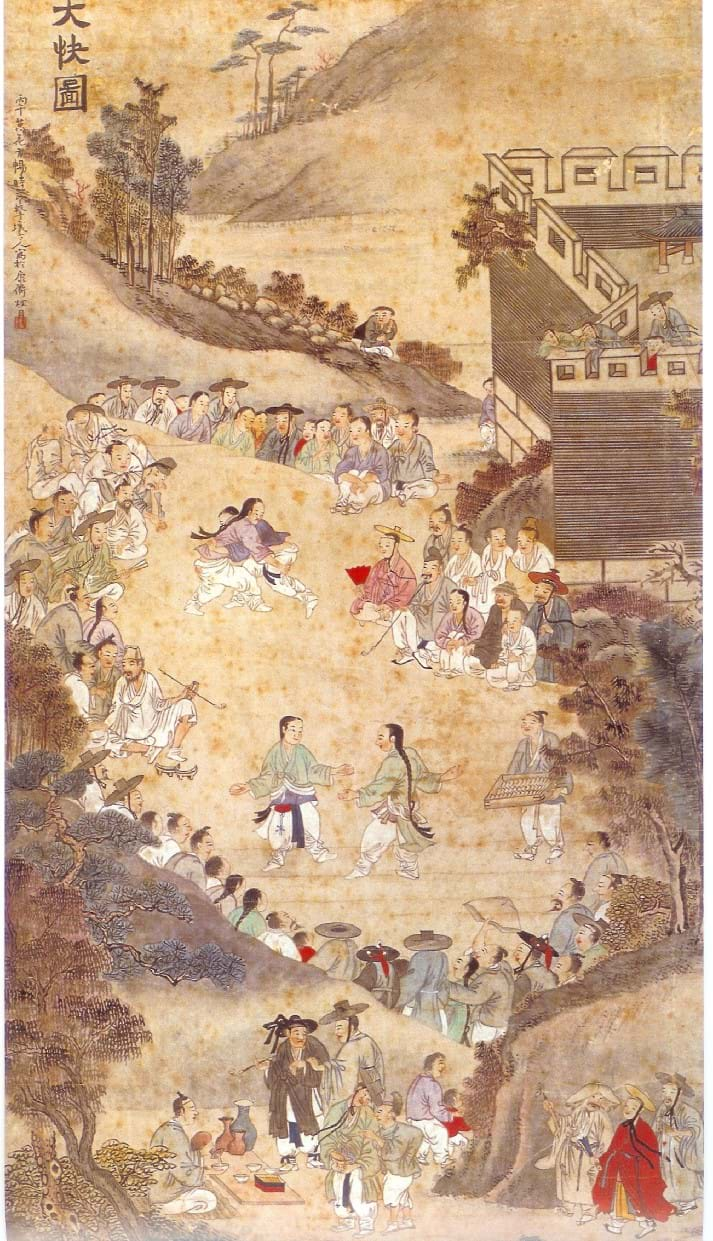
The "Three Kingdoms
There were Three Kingdoms which separately ruled the Korean Peninsula at the beginning of the first Century: Goguryeo, Baekje and Silla. These kingdoms were sometimes at war with each other until Silla took over Baekje in mid 7th Century and Goguryeo in the late 7th Century thus unifying the Korean nation. The Silla dynasty lasted until 10th Century.
Sixth Century map of Korea
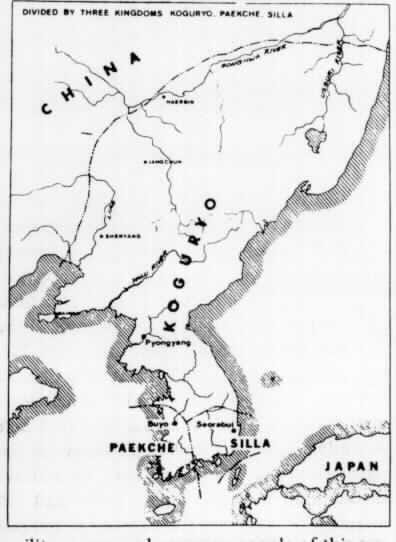
Goguryeo Kingdom (37BC~7th Century)
The Goguryeo Kingdom was founded on the Northern part of Korea which was surrounded by the hostile Han (Chinese) tribes in the North. The Kingdom formed a strong warrior corp known as the "Sun Bae" in an attempt to consolidate it's power. "Sun Bae" means a man of virtue who never recoils from fighting. It defined the best martial arts in Korea and the group became legendary for their martial art moves (In modern Korea, Sun Bae refers to the most senior). In peacetime, it was said that they lived in groups learning history and literary arts as well as serving their appointments for the King which included guarding the Kingdom and building roads and structures. They wore the finest silk and were the designated teachers for the Kingdom, the best martial artists. In wartime, they would organise themselves and defend the Kingdom with their strong willed bravery and their martial art techniques.
The Goguryeo governmental organisation worked on a merit system whereby the best martial art warriors received the highest positions. The "Sun Bae" were chosen from festivals called "Sin Su Do" which were organised in the months of March and October. Events used to decide the "Sun Bae" included archery, sword, dancing and Tae Kyon or Soo Bak (i.e. Taekwondo).
The Taekwondo competitions sometimes involved fighting in pits with wild animals or beneath frozen river beds under the ice. The "Sun Bae" became legendary for their feats of bravery and martial art moves.
Baekje Kingdom (18BC~7th Century)
Although practised, martial art styles were not encouraged by this Kingdom. However, ancient records show that horseback riding, archery and bare handed arts were practised among both the military and the common people during this period.
Silla Kingdom (57BC~10th Century)
Silla founded it's own warrior corp called the "Hwarangdo" who were bound to follow a code of honour comprised of rigid loyalty to the nation, respect and obedience to one’s parents, interminable loyalty to friends, courage in battle and prudence and restraint on using violence. This code remains the philosophical backbone of the modern Taekwondo system.
The "Hwarangdo" followed the same organisational and hierarchical structure as the "Sun Bae".
The Silla dynasty took over Baekje and Goguryeo in 7th Century thus unifying the Korean nation for the first time ever. Silla was succeeded by the Goryeo Dynasty in 10th Century from which the modern name "Korea" was derived.
The Goryeo Dynasty (10th Century~14th Century)
The Goryeo Dynasty developed Taekwondo and martial art techniques more systematically then ever before, so that it might be used by the soldiers in the event of war. Military training for the Goryeo cadets included Taekwondo practice as a compulsory subject and the only personnel who were allowed to join the army were those with martial art abilities. Soldiers who mastered Taekwondo withe the best martial art techniques were promoted to Generals and skilled practitioners were selected to become officers. Many contests called "Subakhui" were held regularly to search for talent.
The Joseon (Yi) Dynasty (14th Century~20th Century)
The Joseon (or Yi) Dynasty was founded by King Taejo on the new ideology of "Confucianism" ("Buddhism" was previously practised). This resulted in the rejection of all Buddhist festivals and more importance was directed towards literary art rather than martial art. The King adopted ideals such as ..."a real man writes poetry, learns to play musical instruments and reads Chinese classics" and the civil officers received higher recognition than the military officers. The new ideals, together with the advent of modern weapons such as gunpowder, caused Taekwondo to loose support from the central government and was not as popular nor did it figure as prominently as it did in the Goryeo Dynasty. Subakhui was still popular, but more as a folk game for the festivals rather than a selection process for the armed forces.
Nevertheless, there were martial art tournaments which were sponsored by the "Ue Hung Bu" (Organisation of National Defence) for the purpose of choosing shield soldiers and guards. Anyone who defeated more than three others would automatically be selected. Common people and especially the slaves continued to practice Taekwondo and enter these events with the hope of winning three events.
200 years after Yi commenced, Korea was invaded by Japan in 16th Century. King Jungo revised the defence measures of the nation to again include martial art practice in military training. In 18th Century, King Chongjo instructed General Lee Duck Mu and scholars Back Je ga and Back Dong Soo to compile a book containing all the martial arts that were known in Korea. The book was called "Me Ye Do Bo Tong Ji" and remains a classic of about forty pages in length.
King Soonjong was the last ruler of the Yi Dynasty which ended with the Japanese occupation in 1910 AD. The Japanese started a colonial government headed by Generals. It was not until the end of WWII in 1945 that the Korean people were liberated.
Modern Times (1910AD~)
Through the centuries, the Korean peninsula was often attacked and invaded, however the fierce spirit of the Taekwondo warriors was never crushed and the martial art was preserved. Since the time of the Three Kingdoms in the first Century, the Art has been carefully handed down from each generation, refined and strengthened in the process.
Korea was again invaded by Japan in 1910 AD and the Japanese started a colonial government headed by Japanese Generals. The government prohibited many Korean traditions including all Taekwondo practice. The speaking of the Korean language was also forbidden and measures were taken to change family names in order to change the identity of the Koreans. Japanese "Karate" was also introduced.
This was a very difficult period for Korea, however Masters and students continued Taekwondo in secret. Some Masters who had learned Taekwondo in the Joseon (Yi) Dynasty continued to teach during the Japanese occupation. Taekwondo was also preserved by other Masters who lived in monasteries. They secretly handed down the knowledge until the liberation of Korea by the Allied forces in 1945.
After World War II and the liberation of the Korean people from the Japanese Armed Forces, the cultural and social aspects of Korea returned to normal and Taekwondo began to improve. The Art of Taekwondo began a new birth into the modern age and the western world. Martial art experts began opening centres all over the country after the end (i.e. the "cease-fire") of the Korean War (1950~1953).
The martial art of Taekwondo has gone by many names such as Tae Kyon, Soo Bak Do, Kong Soo Do, Tang Soo Do and others. However, the Master's main objective since 1945 was to purify Teakwondo and return to the traditional unarmed form and technique that was free from the influences of other martial arts. Many Kwans (schools) appeared and approximately in 1961, the Tae Soo Do association was formed which later changed name to the Korean Taekwondo Association in approximately 1965. Approximately 2000 Taekwondo Black Belt Master Instructors were dispatched to over 100 countries for foreigner's martial art training.
The Kukkiwon (HQ building) was built in 1972 and served as a central training place and the site of various competitions. It became the world headquarters for the World Taekwondo Federation which was formed in 1973 at the 1st World Championships. WTF later changed the name in 2017 to "World Taekwondo".
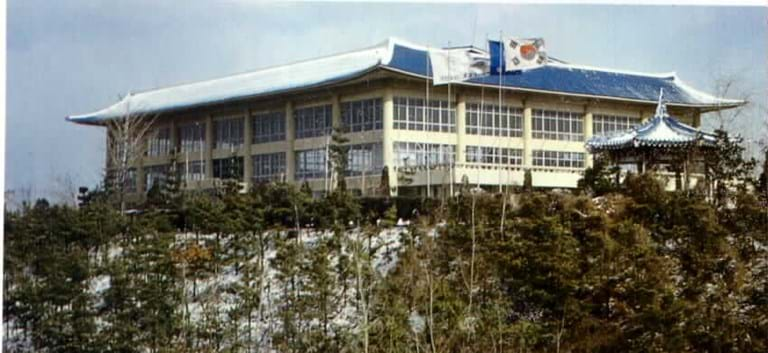
World Taekwondo Headquarters
Kukkiwon Building - World Taekwondo Headquarters. Today, Taekwondo represents not only a traditional martial art but also a modern sport practised by over 70 million people in 200 countries with over 8 million black belts (counted at 2018). Taekwondo has also progressed far enough that it was introduced as a demonstration sport in the 1988 and 1992 Olympics and consequently was part of the Sydney 2000 Olympics as a full medal sport for the first time. The Australian Team managed 2nd place overall with 1 gold medal for the Women and 1 Silver for the Men. Team Korea was successful in 1st place with 3 gold and 1 silver medal. The Taekwondo World Championships have been held every 2 years since 1973.
The Olympic body recognises only one association - the World Taekwondo Association, of which Sun Bae is a proud member.
Sun Bae History
Sun Bae was founded by Master Bradley Tatnell:
- Master Bradley became an instructor of Taekwondo in 1983, learning from the first Taekwondo master to arrive in Australia (Chong Chul Rhee).
- Master Bradley became an instructor of Hapkido in 1998, learning from the first Hapkido master to arrive in Australia (Sung Soo Lee).
- Master Bradley became an instructor of Kumdo in 2011.
Disclaimer
Note: This is a summary from a number Taekwondo texts which were published in Korea 1980~1995 of which were sanctioned by the World Taekwondo Federation. The information is provided in summary form only and is intended for general informational use and should not be relied upon for research material in assignments or otherwise as the information is purportedly subject to change by the South Korean Government (eg Romanisation rules and Dynasty names etc).